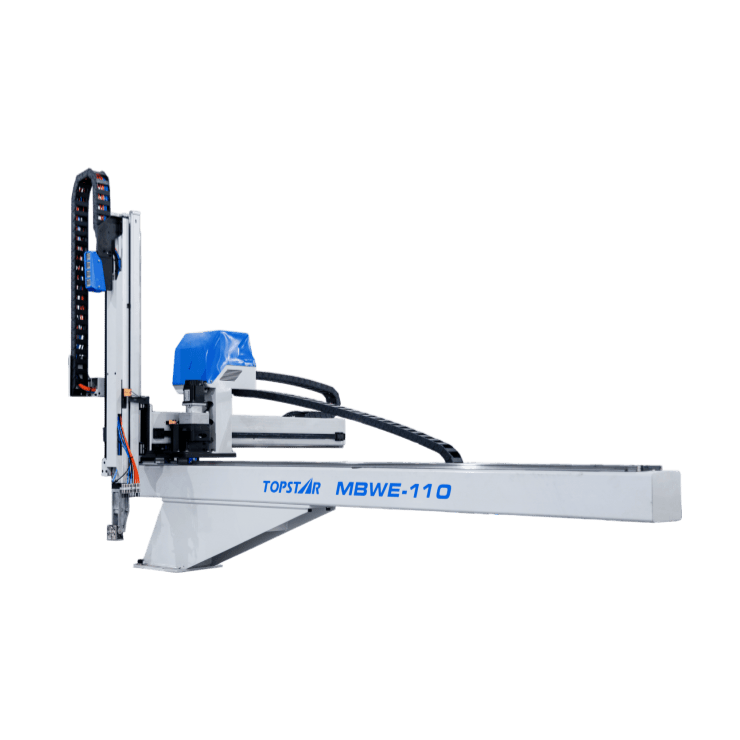
A Cartesian Robot can miss molded parts or trigger unnecessary alarms when the injection molding machine’s actual mold-opening position differs from the position the robot program expects. Mold-opening position compensation addresses this problem by using a signal from the injection molding machine to detect its actual opening position and automatically adjust the robot’s travel. This helps maintain a more consistent pick-up position and reduces repeated program adjustments caused by opening-position deviations. However, the function depends on compatible machine signals, correct robot configuration, and a properly established pick-up reference. It does not replace accurate mold positioning or correct mechanical problems in the injection molding machine.
Why Can Mold-Opening Position Changes Affect Cartesian Robot Pick-Up Consistency?
A Cartesian Robot normally follows programmed movement coordinates to enter the mold area and remove molded parts. If the actual opening position changes but the robot continues to follow an unchanged travel setting, the relationship between the robot’s movement and the mold position may become inconsistent. Understanding this relationship explains why position compensation matters in automated part removal.
How Fixed Pick-Up Coordinates Can Cause Positioning Problems
The robot’s pick-up movement is coordinated with the injection molding machine’s mold-opening sequence. The available space for robot entry and the molded part’s position depend on the mold’s actual opening condition. When the machine stops at a different opening position from the one used during robot setup, the programmed travel may no longer provide the expected clearance or approach position. The robot may enter too far, stop too early, or fail to reach the intended pick-up location.
These deviations can result in missed parts, repeated alarms, or interference between the robot arm and mold components. Operators may then need to adjust the robot’s travel parameters and repeat the setup process. The problem isn’t necessarily poor robot positioning accuracy. A robot can repeat its programmed coordinates accurately while still approaching a mold that has stopped at a different position.
What Mold-Opening Position Compensation Actually Adjusts
Position compensation changes the robot’s travel reference based on the detected mold-opening position. Instead of relying entirely on a fixed opening-position assumption, the robot uses a signal from the injection molding machine to identify the actual position and automatically adjust its movement. Topstar’s T3 and T4 robot materials describe this function as detecting the injection molding machine’s mold-opening position and automatically adjusting the robot’s travel. The stated purpose is to reduce alarms and repeated machine adjustments caused by inaccurate mold-opening positioning.
This is particularly relevant when the robot needs to reach a consistent pick-up area across successive production cycles. By adjusting travel according to the detected position, the system can better maintain the intended relationship between the robot arm and the mold. However, compensation does not correct every possible cause of a missed pick-up. Incorrect fixture positioning, unstable part release, unsuitable robot coordinates, or mechanical problems still require separate investigation.
How Does a Cartesian Coordinate Robot Use Machine Signals to Adjust Its Travel?
Position compensation depends on communication between the injection molding machine and the robot controller. The machine provides the relevant opening-position signal, and the robot uses that information to adjust its programmed travel. Therefore, check both the signal connection and the movement configuration before relying on this function in production.
Verify Signal Availability and Robot Control Configuration
First, confirm that the injection molding machine can provide the required mold-opening position signal and that the selected injection molding robot supports the corresponding compensation function. The control system must map the signal correctly, and its meaning must match the robot’s intended movement reference. A general machine-running signal should not automatically be treated as an actual opening-position measurement.
Topstar‘s robot documentation also identifies RS485 communication with MODBUS RTU support on applicable configurations. However, this communication capability should not be confused with the specific machine signal used for mold-opening position compensation. Confirm the actual interface and signal arrangement for the selected machine and robot combination. During commissioning, engineers should verify that the robot receives the correct signal at the appropriate stage of the mold-opening sequence. Incorrect signal mapping or timing can cause the compensation function to work from an unsuitable reference.
Understand the Role of Axis Softening
Position compensation and axis softening are related to pick-up reliability, but they address different aspects of robot movement.
Topstar’s English injection robot manual describes an axis-softening function intended to help prevent missed pick-ups or robot arm damage when the mold-opening position changes. This function provides a more compliant response to changes during robot movement. Position compensation, by comparison, uses the detected opening position to adjust the robot’s travel. Axis softening addresses how the robot axes respond to movement conditions.
These functions are not interchangeable and are not available on every robot model. Manufacturers should confirm the selected model’s configuration and determine which functions are included in the intended application.
What Should Be Verified Before Using Position Compensation in Production?
Automatic travel adjustment can improve pick-up consistency, but it must be configured against the actual mold, machine, and robot arrangement. Before releasing to production, the team should verify the reference position, signal behavior, available movement clearance, and part-removal sequence. These checks help distinguish genuine compensation benefits from problems that require mechanical or program adjustments.
Check Mold Reference Positions and Robot Travel Limits
Start by confirming the mold’s intended opening position, robot entry clearance, and programmed pick-up coordinates. The robot must have sufficient travel to reach the part without interfering with the mold, ejector system, or other machine components. Check the signal response at the relevant stages of mold opening and compare it with the robot’s expected movement. Also inspect the end-of-arm tooling and pick-up point. Compensation cannot correct an incorrectly positioned gripper or a part that has not been released properly. A Cartesian Robot Manufacturer should review these conditions together rather than treating the compensation setting as an isolated software adjustment.
Validate Pick-Up Consistency Across Production Cycles
After configuration, conduct controlled production trials using the intended mold and robot program. Observe whether the robot reaches the expected pick-up area when the machine reports its opening position. Record missed pick-ups, positioning alarms, unexpected movement, and any repeated adjustments required during operation. If inconsistencies remain, check signal timing, reference settings, mold-opening stability, and gripper positioning before changing multiple parameters simultaneously.
Topstar’s position-compensation function is intended to reduce unnecessary setup adjustments and alarms associated with mold-opening position deviations. However, its effectiveness should still be evaluated against the actual machine configuration and production conditions. For manufacturers integrating a Cartesian Coordinate Robot into an automated molding cell, the practical objective is not simply to make the robot move faster. It is to maintain a reliable relationship between machine movement and robot pick-up coordinates. When the signal, reference, and travel configuration match correctly, mold-opening position compensation can reduce missed pick-ups and make automated part removal more consistent.