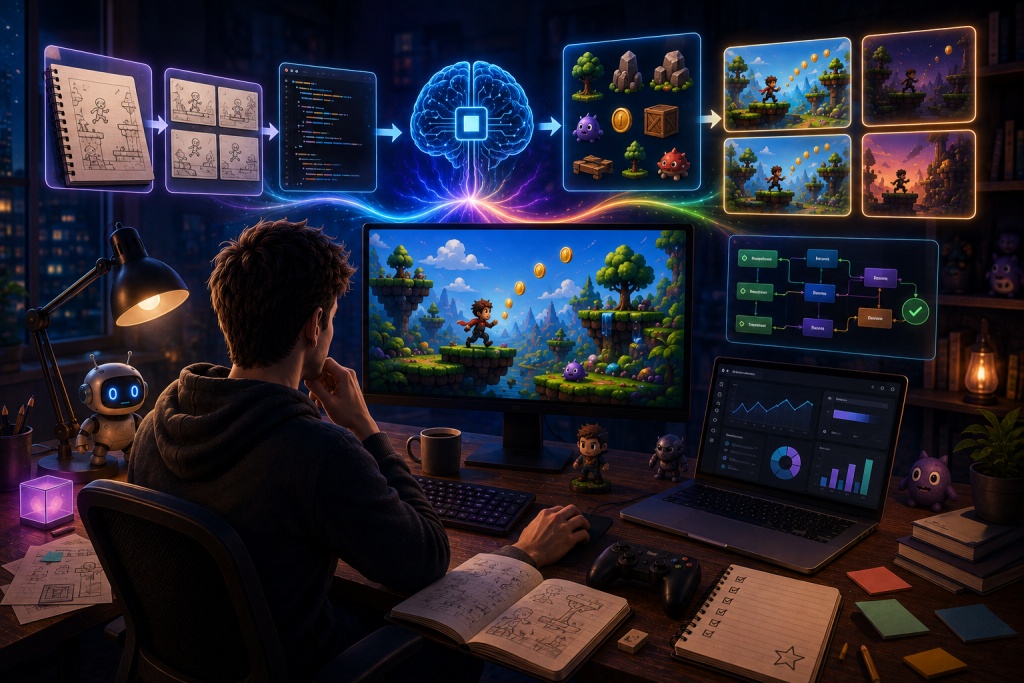
There’s a difference between an indie developer succeeding commercially and an indie developer building a genuinely better game, and the second one is arguably the more interesting shift happening right now. AI isn’t just helping indie developers ship more or reach more players. It’s changing the actual quality of what gets built, because the time saved on implementation is going straight back into the decisions that make a game good.
Why “Better” Isn’t the Same as “Faster”
Speed Alone Doesn’t Improve Quality
Producing a game quickly doesn’t automatically make it good. Plenty of fast, AI-assisted prototypes are rough and unfinished, the same way plenty of slow, manually coded games are rough and unfinished. Quality comes from what happens after the first version exists: testing, refining, cutting what doesn’t work. AI’s real contribution is making more of that refinement possible within the same amount of time.
Better Games Come From More Genuine Iteration
An indie developer who tests one idea and ships it is working differently than one who tests five variations, compares them honestly, and refines the strongest one repeatedly. AI makes the second approach realistic for a solo developer or small team in a way it simply wasn’t before, and that difference shows up directly in the final product.
Where AI Actually Improves the Final Game, Not Just the Process
Catching Weak Mechanics Before They’re Expensive to Fix
Indie developers using create game platforms can test a core mechanic within hours instead of weeks. That earlier discovery point means a weak idea gets caught and corrected before an entire game gets built around it, which directly improves the quality of what eventually ships, since the foundation was actually validated rather than assumed.
More Playtesting Cycles Per Project
Because builds happen faster, indie developers can playtest more frequently throughout development rather than only at a few major milestones. Games like State Conquest reflect what that kind of frequent, iterative testing can produce, a strategic system with real depth and balance that likely came from many rounds of adjustment based on how it actually played, not a single guess that happened to work.
Freeing Time for the Details That Separate Good From Great
Every hour saved on manual implementation is an hour an indie developer can spend on the small things that matter enormously to final quality: tightening input response, refining the exact timing of feedback, smoothing a difficulty curve that felt slightly off. These details rarely get enough attention when implementation eats most of the available time, and AI changes that balance directly.
How Indie Developers Are Actually Building Better With These Tools
Comparing Variations Instead of Committing Early
Rather than settling on the first version of a mechanic that technically works, indie developers increasingly generate two or three variations and compare them directly. That habit alone tends to produce noticeably stronger final decisions than committing out of necessity because rebuilding alternatives used to be too costly.
Treating the First Version as a Draft, Not a Deliverable
The best results come from developers who resist the temptation to ship the first generated version. Using that version purely as a starting point, and holding it to the same critical standard as anything built manually, is what actually turns speed into quality rather than just quantity.
Reinvesting Saved Time Into Polish, Not Just More Content
Indie developers who use their saved implementation time to add more features often end up with a broader but less refined game. The ones building genuinely better games tend to reinvest that time into depth and polish on a smaller, tighter scope instead.
What Still Determines Whether the Result Is Actually Better
Honest Evaluation Still Has to Happen
AI can generate a working version quickly, but it has no opinion on whether that version is good. An indie developer still has to playtest honestly, notice what isn’t working, and be willing to change course, exactly as they always have.
Design Taste Doesn’t Come From the Tool
Two developers using the same platform with different instincts for pacing, fairness, and feel will produce noticeably different results. The tool accelerates execution. It doesn’t supply the taste that determines whether a game is genuinely well-designed.
Discipline to Cut What Isn’t Working
Faster iteration only improves a game if the developer is willing to discard ideas that don’t hold up under testing. Generating more options without the discipline to cut weak ones just produces more content, not better content.
A Practical Approach for Building Better, Not Just Faster
- Use extra speed to test more variations, not to skip testing altogether.
- Treat every generated version as a draft requiring honest evaluation.
- Playtest more frequently throughout development, not just at the end.
- Reinvest saved time into polish and depth rather than added scope.
- Stay willing to cut ideas that don’t hold up, regardless of how fast they were to produce.
Final Thoughts
AI is helping indie developers build better games not by making decisions for them, but by giving them room to iterate more thoroughly than a solo creator or small team could previously manage. The quality improvement isn’t automatic, it comes from how that extra time and flexibility actually gets used.
The indie developers seeing the clearest quality gains aren’t the ones producing the most content the fastest. They’re the ones using that speed to test more, refine more carefully, and hold their own early drafts to a genuinely critical standard before calling anything finished.